

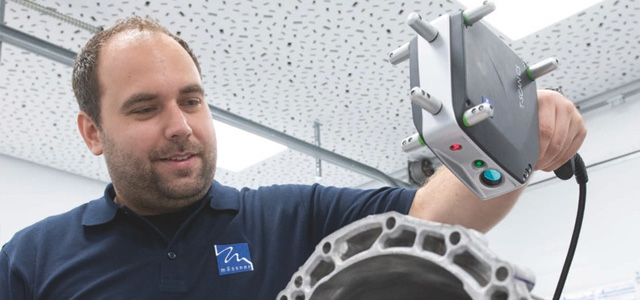
German company August Mössner GmbH & Co. KG optimizes production and programming with ZEISS T-SCAN
August Mössner GmbH is a manufacturer of specialized machinery for the foundry and aluminum industries and equipment for the decommissioning of nuclear power plants. With the help of ZEISS T SCAN, equipment programming is optimized with flexible laser scanning.
When a robot grabs a cylinder block weighing 50 kilos and approaches a saw or milling cutter, any vibration or sliding movement must be avoided. But deviations from production data targets make it difficult for robots to grasp. August Mössner GmbH & Co. KG, which manufactures specialized machinery for the foundry and aluminum industries along with saws for the widest possible variety of materials, as well as equipment for the decommissioning of nuclear power plants, has found a solution to this problem. In addition to tailor-made manipulators for robots manufactured with the help of ZEISS T SCAN, the equipment's programming is optimized with flexible laser scanning.
The robot's two arms stretch their necks stiffly in the air, their movements seem frozen. One of them holds a suspended cylinder block, which weighs at least 50 kilos. Only in a few weeks, when the entire plant is completed, will they begin moving in and cutting out disruptive feeder and drinker systems and milling casting flares into engine blocks that come from a foundry. To do this, they push the pieces into saws and routers that protrude from the wall and look like giant dental drills.
However, here in Eschach is not where they will be put to work, but rather in the engine plants of well-known car manufacturers. The processing stations are designed and put into trial operation at August Mössner in Eschach. Mössner has a reputation in the automotive industry for delivering automated production lines with dozens of robots on time and perfectly functional.
Deviations of several millimeters. Christian Kunz's team plays an important role when it comes to deviations. The 20 employees in its robotics, research and development department are responsible for planning the precise, safe and efficient operation of the processing lines.
But the devil is in the details. One of these details is the contour parts with which the robots grab the cylinder block. They are as small as a hockey puck, but you must be able to grip the frame accurately and hold it in position during processing, against the forces that occur. For this purpose, the contour parts have gaps that fit exactly over the protrusions of the castings. However, this is not the case initially.
Kunz keeps a portion of the rough-cast outline of a gearbox, at the point where the robot will then pick up the component, but no matter how the mechatronics engineer rotates and tilts the fixture, the pieces don't fit. “When car manufacturers send us castings, they often deviate from the target design by a few millimeters,” explains Kunz.
This is not surprising, since most of them are so-called starting parts for new types of engines.
Tolerances remain large when series production begins and are not shown in the CAD models of the castings. Kunz and his team have found a solution in which ZEISS T-SCAN is of central importance. Using a handheld laser scanner, engineers measure the contour of the surface of the casting, for example an engine block or transmission housing, and compare the data set generated by this with the target CAD data supplied by the automobile manufacturer. On the one hand, this serves to document the actual state, and on the other hand, the measurement is the basis for adapting the contour parts to the frame and for subsequent programming of the robot. This way, engineers can quickly see where there are deviations and can immediately start reworking the contour parts. The contour part is reworked by hand, then scanned and can therefore be documented and converted into CAD data.
Significant time savings The decision to buy from ZEISS
T-SCAN was taken in 2017. The free handling within the measuring field was particularly convincing, says Kunz: “With the ZEISS T-SCAN we can also capture large and very heavy parts from all four sides and from above without having to laboriously move the part.
Such a flexible measurement process would not have been possible with a competitor's stationary solution. Furthermore, ZEISS T-SCAN is a portable system with a high degree of ease of use. This means that, if necessary, components can be measured directly at the customer's premises after processing in the robot cell. This saves valuable time, especially when starting a new system. Configuration takes only 10 minutes,” says Kunz, “and together with the customer we can quickly verify the processing result. Since the modular system does not require a physical connection to a measurement table, data acquisition is easy and effortless, even in hard-to-reach areas.
SEE FULL NOTEHERE