All 3D Printing processes start from a 3D design, which once completed can be printed under the “idea” concept. With this product in hand, details are seen and it is optimized by making adjustments to the 3D design itself. Printing the headband, depending on the model and type of equipment used with FDM technology, may take 2 to 3 hours.
In one day it is possible to print several projects until the optimal design is achieved, then assemble, for example, the protector and rear elastic to carry out tests in the workplace with the end user.
On the second day we are already in a position to launch “prototypes” that can be published and distributed with recommendations for their use.
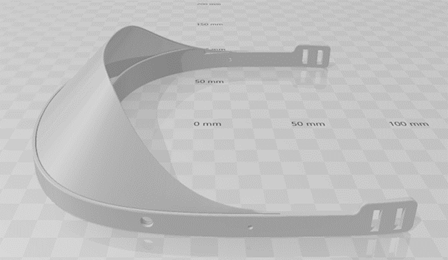
The 3D design of this headband that circulates on the networks, applying 3D printer software, can be processed and thus know the time necessary for printing, the amount of model and support material that will need to be consumed for a product. Also simulate different forms of printing on the equipment tray or quantities of simultaneous pieces to print. Then the user who needs to estimate the costs will be able to do so considering the amortization of their equipment, printing time and the value per kg or volume of the filament, being able to know precisely the final value of the product, even before printing it.
Depending on the available printer, changes can also be made through the software in the production time or material to be used with parameters such as printing density and layer height. With low density the process uses less printing filament, thicker layers will give greater mechanical resistance, less printing time but a visually more wavy surface with low quality of details in its finish.
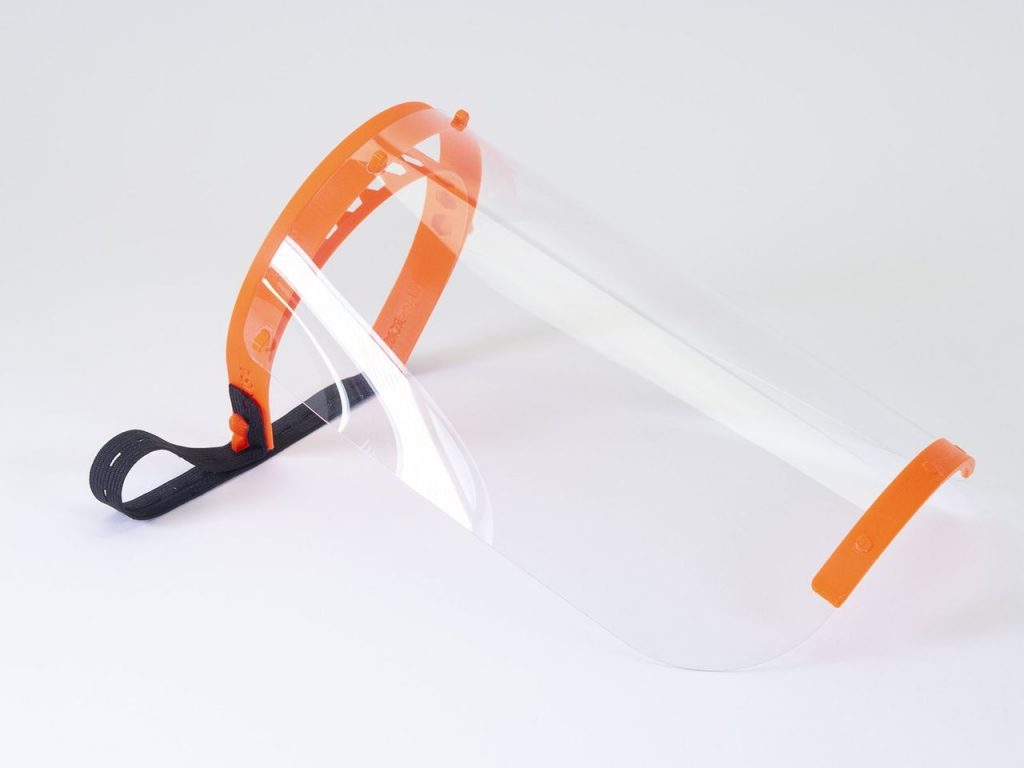
Below we detail calculation examples for 3D printing on two Professional line equipment with investments that can vary from US$3,000 to US$5,000 depending on the model and configuration.
KodaK Team80% infill, 0.3 layer height, paddle base Grams 34gr Time 3 hours – COST of printed piece weights 95 per unit.
MakerBot Team80% infill, 0.3 layer height, without base Grams 34.2gr Time 2.5 hours – COST of printed piece weights 98 per unit.
The most commonly used printing filament for these products is PLA, a plant-based material with sufficient physical conditions for the demands of a headband, which does not damage the skin upon contact and is biodegradable. There are other options such as ABS with better mechanical performance but which may require slightly more complex printers, generate certain gases and may have limitations on contact time with the skin.
The post-processing of a printed piece is another point to consider, a 3D print may require removing some small printed parts as support in the printing process, sanding or dilution of the support material if a more advanced technology is used, waterproofing, painting or 3D quality control using optical or laser scanners.
Product design plays a primary role when analyzing parts to be printed. It is a big mistake to believe that a design designed for an extractive manufacturing process (using machining centers or CNC lathes) can be printed efficiently without re-engineering it to be manufactured using Additive systems. Drawing holes in a part in an Extractive Manufacturing process then involves chip removal, cutting tools, energy consumption and machine time. In an Additive Manufacturing process such as 3D Printing, the holes will bring a decrease in material consumption and shorter printing time.
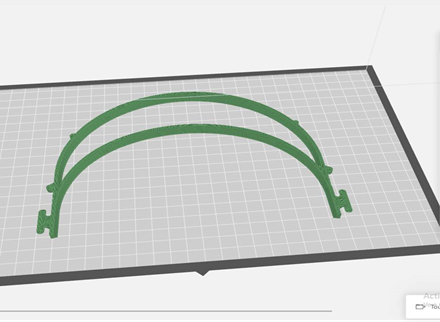
The headband design that we see below is simpler than the previous one and from the point of view of 3D Printing it will be faster and cheaper, then the user must see the functionality and security that one or another design provides in its final application.
There are more complex 3D Printed products, for example for closed masks or respirators, with post-sterilization processes that are being carried out entirely in Argentina in support of the COVID-19 emergency. In these cases, due to their physical and precision requirements, we apply Stratasys Industrial equipment and supplies if the application is with polymers. There are other solutions if the 3D printing is in Metal.
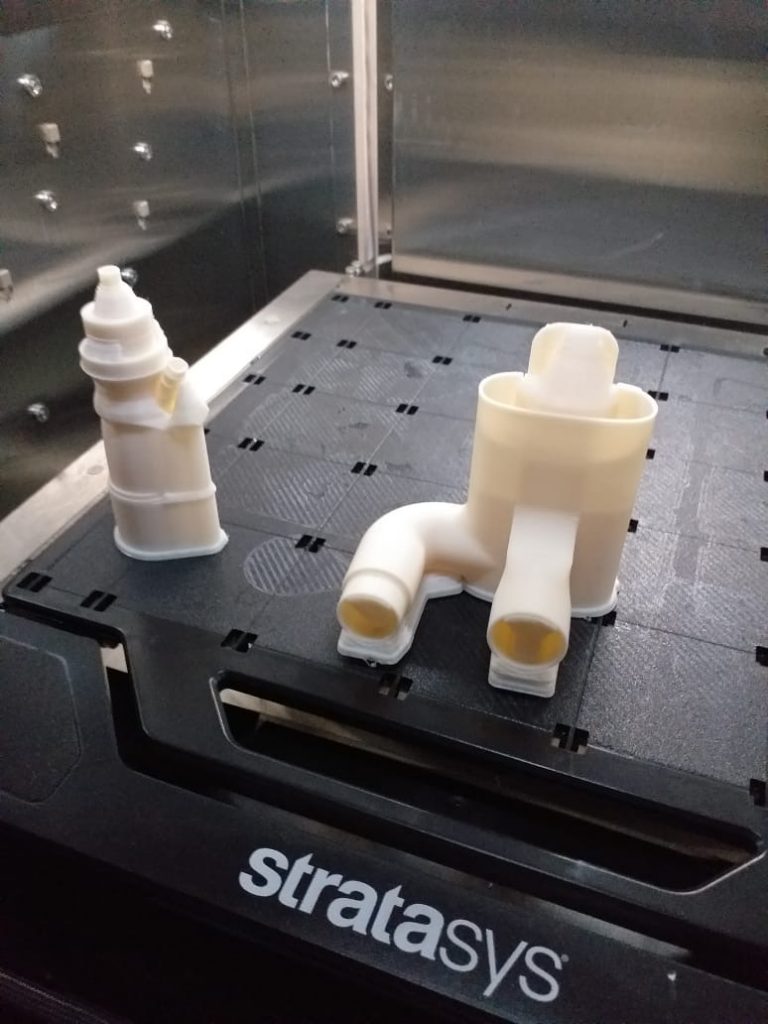
Stratasys F270 Team– Valve piece Layer height 0.17mm, low density.
Printing time 7 hours 26 minutes. Model Material 32.39 cubic centimeters. Support Material diluted 29.43 cubic centimeters. (see photo)
Stratasys F270 Team– Mask Tube piece Layer height 0.17mm, low density.
Printing time 4 hours 36 minutes. Model Material 16.01 cubic centimeters. Support Material diluted 19.13 cubic centimeters. (see photo)
We must highlight that in the medical area, being able to make a product through Extractive Manufacturing (machining) or Additive Manufacturing (3D Printing) is only the beginning of a path, given that the ANMAT and the corresponding medical entities will be the ones who define whether the final product complies with current regulations and only after its certification will it be released for use.
It is also interesting to consider that the mass production of the headbands by designing the matrix for its plastic injection, machining it, carrying out its fine-tuning in the injection molding machine may be available in about three weeks and from that moment on be manufactured in thousands per day, with prices per piece many times lower than those 3D printed.
3D printing is a Manufacturing technique that came to add to existing processes and provide Innovative solutions, but the big change is that it is available to creative people in their homes, SMEs and large Companies with the same Intensity and Potential.
Eng. Aldo Di Federico – Director